
Two separate problems wearing one label
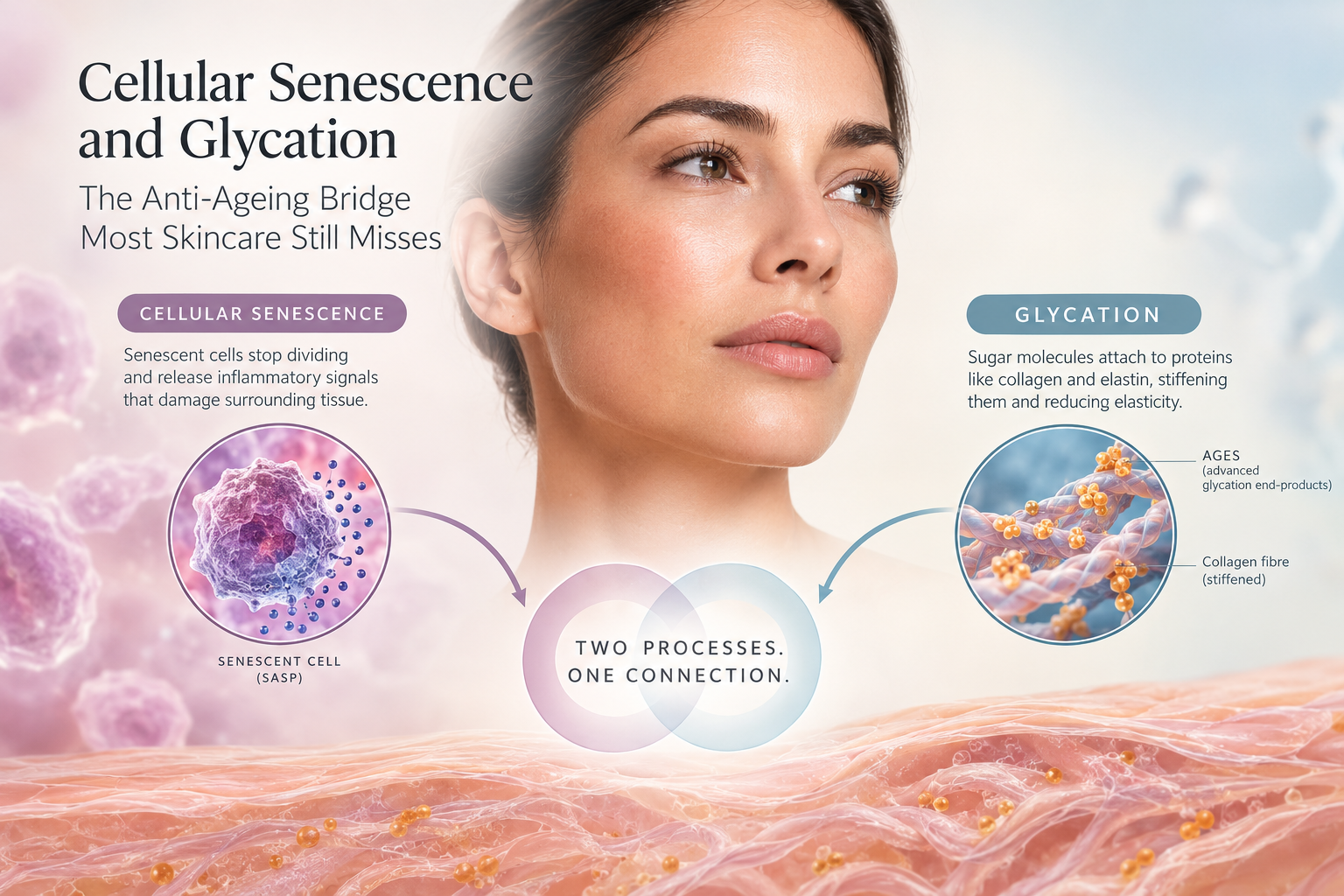
For years, “anti-ageing” skincare has treated ageing as a single process: something that happens gradually and more or less uniformly, addressed with one hero ingredient after another. The 2026 literature says otherwise. Two distinct biological mechanisms, cellular senescence and glycation, are now understood to drive visible skin ageing through different pathways, and new research shows they are more connected than previously assumed: one can trigger the other.
Getting this distinction right matters commercially, not just scientifically. A brand that wants a defensible anti-ageing claim in 2026 needs to know which mechanism its active ingredient actually addresses, because the evidence required to substantiate each one is different.
What “zombie cells” actually do
Cellular senescence reached mainstream attention this year on the back of a striking headline: a topical drug reversing skin ageing and speeding wound healing in mice. Researchers at Boston University’s Chobanian and Avedisian School of Medicine, led by Daniel S. Roh, tested ABT-263, a senolytic compound that clears senescent cells rather than merely suppressing them. By day 24, 80% of treated aged mice had fully healed wounds, compared with 56% of untreated aged mice, alongside increased expression of genes linked to collagen production and new blood vessel formation (ScienceDaily, reporting on the Roh lab’s paper in Aging). The caveat matters as much as the result: this is mouse data, and the authors are explicit that safety and efficacy in people are still unknown.
Senescent cells do not die. They stop dividing and begin releasing a cocktail of inflammatory signals, known as the senescence-associated secretory phenotype (SASP), that damages the tissue around them. A July 2026 GeroScience review from Haykal and colleagues lays out the two main ways to intervene: senolytics, which clear senescent cells outright (dasatinib plus quercetin, fisetin, and navitoclax, the class ABT-263 belongs to), and senomorphics, which suppress the SASP without killing the cell (rapamycin, metformin, JAK inhibitors, certain flavonoids). The review is specific about the damage SASP does to skin: it degrades extracellular matrix components, disrupts pigmentary balance, and impairs barrier function, three mechanisms we have already written about separately in Why Your Skin Barrier Is Broken and Why Melanin-Rich Skin Scars Differently. Senescence is not a side plot to those stories. It may be a shared upstream cause.
Where glycation comes in
Glycation is a separate process: sugar molecules attaching to proteins like collagen and elastin, stiffening them and reducing the skin’s elasticity over time. It has long been treated as a purely structural problem, something you see in cross-linked collagen fibres under a microscope. New research from The Estee Lauder Companies’ Global Research & Innovation group, published in the International Journal of Molecular Sciences, complicates that picture. Their in vitro work found that sugar also glycates proteins inside skin cells themselves, not just the collagen matrix outside them, triggering inflammation and pushing affected cells into senescence. “By identifying glycation as a cellular disruptor, this study opens the door to new strategies in adaptation science,” said Dr Claude Saliou, the company’s Senior Vice President of Advanced Technologies and Global Clinical and Consumer Sciences.
That finding is the bridge this topic has been building toward: glycation is not just a separate ageing mechanism running in parallel to senescence, it is one of the ways cells become senescent in the first place. A second 2026 paper in the Journal of Cosmetic Dermatology, Haykal’s “Skin Glycomics: Unmasking the Role of Glycation End Products in Cutaneous Aging and Dermatology,” and a companion piece, “Translating Geroscience Into Clinical Longevity Dermatology,” both published this year, place glycation squarely inside the same geroscience framework as senescence rather than treating it as a side issue. Three independent research groups converging on the same mechanistic link inside a few months is a strong signal, not a coincidence.
Why this changes what a claim needs to prove
This matters for anyone formulating or validating a cosmetic active ingredient. “Anti-ageing” as a single claim category increasingly does not map to how the underlying science works. An ingredient that reduces AGE (advanced glycation end-product) cross-linking is not addressing the same mechanism as one that clears senescent cells or suppresses SASP signalling, and a brand making a broad anti-ageing claim without knowing which mechanism its formulation actually hits is building a weak claim on strong-sounding language.
Cellular skincare, in the sense of actives designed to work at the level of individual cell behaviour rather than just the visible surface, needs mechanism-specific evidence: which pathway is targeted, what assay demonstrates it, and what that assay cannot tell you. That is precisely the gap a structured Validation Programme is built to close, with tiers running from core efficacy testing through to full claims-ready evidence packages, and it is also where a Discovery Sprint earns its keep, screening candidate actives against a defined mechanism rather than a vague ageing brief.
Where this goes next
None of the three 2026 publications behind this piece are cosmetic science in the narrow sense. They are dermatology and gerontology research finding their way, fast, into a category that has mostly sold ageing as one story. Brands that get ahead of that shift, by being specific about which mechanism their cosmetic active ingredients target and backing it with evidence rather than a single ingredient name, will be the ones still making defensible claims when the category catches up.
If you are formulating or validating an anti-ageing active and are not sure whether your evidence actually supports a senescence claim, a glycation claim, or both, that is exactly the kind of question a free R&D Diagnostic is built to answer. Book a 30 minute R&D Diagnostic and we will help you work out which one you are actually making. Questions or thoughts on this? Drop them in the comments or send us a message, we read every one.