
What Is Melanin in Skin? The Complete Science of Pigmentation, Protection & Why It Matters
Melanin is the pigment that gives your skin its colour, but it does so much more than that. Far from being just a “skin tone determinant,” melanin is a sophisticated biological defence system that has protected humans for thousands of years. Yet myths and oversimplifications still dominate conversations around skin colour, sun protection, and hyperpigmentation.
In this guide, we break down exactly what melanin is, how it’s produced, why it matters for skin health, and its complex relationship with UV exposure. We also introduce our new book, MELANIN: The Science of Skin, Colour, and the Biology We Share by Dr Olusola (Sola) Idowu easy read science-first exploration of this fascinating molecule.
What Exactly Is Melanin?
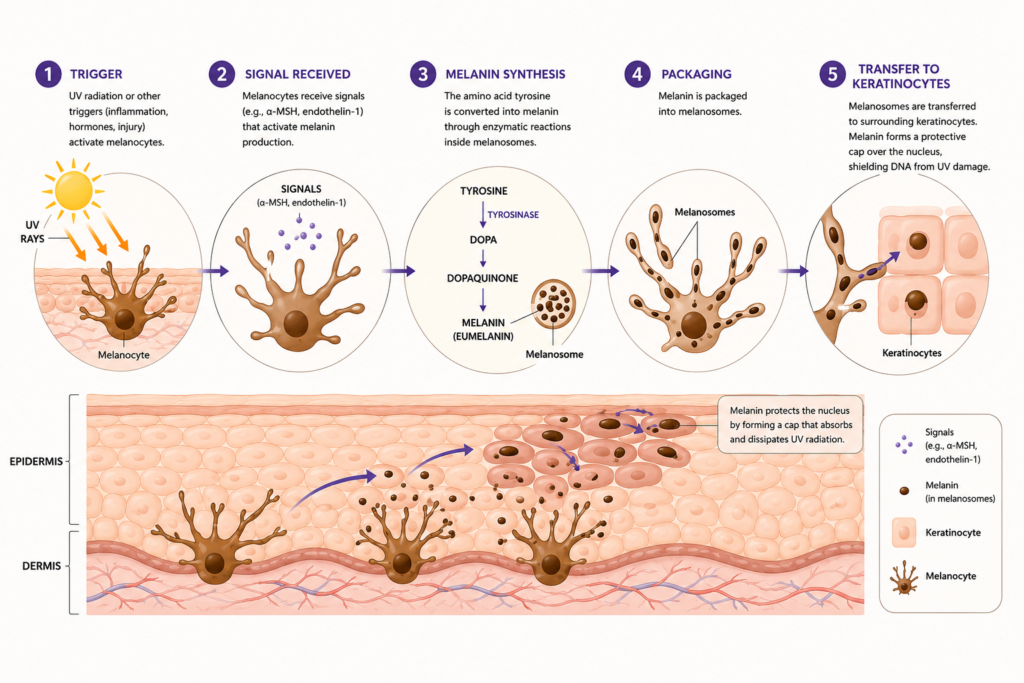
Melanin is a class of pigments produced by specialised cells called melanocytes, primarily located in the basal layer of the epidermis. There are two main types:
- Eumelanin: brown to black pigment (most common in darker skin tones)
- Pheomelanin: red to yellow pigment (more common in lighter skin with freckles or red hair)
The amount, type, and distribution of melanin determine your constitutive (natural) skin colour.
How Is Melanin Produced? (Melanogenesis)
The process begins when your skin is exposed to UV radiation or other triggers. Melanocytes receive signals and begin converting the amino acid tyrosine into melanin through a series of enzymatic reactions. This newly produced melanin is then packaged into melanosomes and transferred to surrounding skin cells (keratinocytes), where it forms a protective cap over the nucleus.
The Protective Power of Melanin
One of melanin’s most important roles is photoprotection. Higher levels of eumelanin absorb and scatter UV radiation before it can damage DNA in skin cells. This is why people with darker skin tones generally have:
- Lower rates of certain types of skin cancer
- Slower visible photoageing in some respects
However, melanin is not a complete sunscreen. It offers partial protection (roughly equivalent to SPF 2–5 depending on skin type), which is why daily broad-spectrum sunscreen is still essential for all skin tones.
Melanin, Hyperpigmentation & Post-Inflammatory Marks
When melanocytes become overactive or unevenly distributed, excess melanin can lead to hyperpigmentation including post-inflammatory hyperpigmentation (PIH), melasma, and dark spots.
This is especially common in melanin-rich skin. Understanding the pathways that control melanin production is key to developing effective, non-irritating treatments.
Read our deep dive: Understanding Hyperpigmentation: Melanin Pathways, UV Influence, and Treatment Targets
The Vitamin D Trade-Off (The Nuance Most People Miss)
Higher melanin levels reduce the skin’s ability to synthesise Vitamin D from sunlight. This creates an important balance between UV protection and Vitamin D status something we explore in detail in our new book.
Why We Wrote the Book on Melanin
After years of research at Hexis Lab using AI and big data to understand how different skin types respond to ingredients and environmental stressors, we realised there was no single, accessible, science-first resource that explained melanin in its full complexity.
MELANIN: The Science of Skin, Colour, and the Biology We Share by Dr Olusola Idowu fills that gap.
It cuts through misinformation and delivers the real biology from melanogenesis and UV interaction to implications for personalised skincare and product development.
If you want the complete, in-depth picture including the latest research on melanin pathways, ethnic skin differences, and what it all means for the future of skincare our new book is the definitive guide.
Get your copy of MELANIN: The Science of Skin, Colour, and the Biology We Share on Amazon
Conclusion
Melanin is one of nature’s most elegant solutions a pigment that protects, defines, and connects us. Understanding it properly is the foundation of better skincare, better product formulation, and better conversations about skin colour.
Whether you’re dealing with hyperpigmentation, developing skincare products, or simply curious about the biology behind skin tone, this knowledge matters.
What’s your biggest question about melanin? Drop it in the comments below we read every one.
And if you want to go deeper than any blog post can go, grab our new book today.
Buy MELANIN: The Science of Skin, Colour, and the Biology We Share