
Glycation is the covalent bonding of sugar (typically glucose or fructose) to a protein, nucleic acid, or lipid molecule. This process is non-enzymatic, spontaneous, and can compromise protein function due to the formation of advanced glycation end products (AGEs) in skin (Chen et al., 2022). Glycation and skin ageing are closely linked, as AGE content in the skin interstitial tissue and on collagen fibres rapidly increases with age. This is due to lengthening turnover rate of collagen production and destruction with age, which promotes AGE accumulation, since AGEs bound to collagen aren’t cleared as regularly (Verzijl et al., 2000). Understanding this relationship forms the foundation of many anti-glycation skincare strategies aimed at maintaining healthy dermal structure.
AGE accumulation greatly influences the dynamic balance of skin and is a factor for skin-related pathologies. AGE has been shown to reduce ceramide and cholesterol in the skin epidermis, delaying self-repair of the skin barrier (Park et al., 2011). Furthermore, keratinocytes are disordered in the epidermal layer when under the influence of glycation, decreasing the integrity of the stratum corneum (Park et al., 2011). AGEs upregulate MMP9 expression via the RAGE receptor pathway skin, and since MMP9 is responsible for extracellular matrix (ECM) degradation and tissue remodelling, this upregulation can obstruct skin wound healing and result in visible signs of ageing (Park et al., 2011). Because this contributes directly to collagen damage, it becomes essential to explore methods of collagen cross-linking prevention.
AGEs have the highest expression level in skin fibroblasts, and therefore AGE-induced reactive oxygen species (ROS) production and inflammation induction have the greatest effects on skin health (Chen et al., 2022). These effects highlight the importance of glycoxidation prevention skincare, as both oxidative stress and glycation processes accelerate dermal ageing. Therefore, it is vital to prevent AGE formation and reduce their effects to ensure efficient skin health and function.
Figure 1:
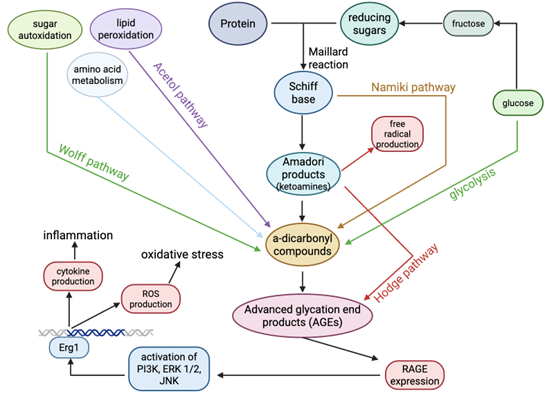
Figure 1: Advanced Glycation End product (AGE) formation (Cepas et al., 2020). AGE formation occurs via multiple pathways, all resulting in the production of dicarbonyl compounds, which can react irreversibly with arginine, cysteine and lysine to form AGEs. AGEs bind to RAGE, the receptor for advanced glycation end products, which is a transmembrane receptor that once activated can influence gene expression. RAGE-induced Erg1 transcription factor activation can induce cytokine production, reactive oxygen species production, and MMP production (Cepas et al., 2020). This causes inflammatory conditions that contribute to ECM remodelling in the skin.
Methods of preventing negative AGE-related effects include upregulating anti-glycation pathways and downregulating pathways promoting glycation. Downregulating synthesis of RAGE receptors will reduce proinflammatory pathway activation, preventing unnecessary cytokine storms which can cause ROS formation (Gkogkolou and Böhm, 2012). Similarly, upregulation of RAGE-inhibitor protein production will mitigate AGE-induced inflammatory responses (Rochín-Hernández et al., 2022). This mechanism is a promising focus for developing RAGE inhibitors cosmetics designed to block glycation-triggered inflammation.
Downregulating MMP production and upregulation of tissue inhibitors of metalloproteinases (TIMPs) will preserve collagen structure and prevent collagen cross-linking caused by glycation (Rochín-Hernández et al., 2022). This aligns with strategies involving MMP inhibition in skincare to protect dermal integrity. Upregulating glyoxalase systems increases detoxification of reactive glycation intermediates (dicarbonyl compounds), supporting glycoxidation prevention skincare approaches. Additionally, various botanicals and phytoactives are being explored as natural anti-glycation ingredients, offering multifunctional antioxidant and collagen protection antioxidants benefits.
Preventing any pathological reactions that could potentially damage the skin is vital to reducing ageing effects, and tight control of AGE-formation pathways is key to maintaining optimal skin health. This underscores the growing importance of advanced anti-glycation skincare formulations in the prevention of glycation-driven ageing processes.
Sources and related content
[1] – Cepas, V.; Collino, M.; Mayo, J.C.; Sainz, R.M. Redox signaling and advanced glycation endproducts (AGEs) in diet-related diseases. Antioxidants 2020, 9, 142.
[2] – Chen, C.-y.; Zhang, J.-Q.; Li, L.; Guo, M.-m.; He, Y.-f.; Dong, Y.-m.; Meng, H.; Yi, F. Advanced glycation end products in the skin: molecular mechanisms, methods of measurement, and inhibitory pathways. Frontiers in Medicine 2022, 9, 837222.
[3] – Gkogkolou, P.; Böhm, M. Advanced glycation end products: Key players in skin aging? Dermato-Endocrinology 2012, 4, 259–270.
[4] – Park, H.Y.; Kim, J.H.; Jung, M.; Chung, C.H.; Hasham, R.; Park, C.S.; Choi, E.H. A long-standing hyperglycaemic condition impairs skin barrier by accelerating skin ageing process. Experimental Dermatology 2011, 20, 969–974.
[5] – Rochín-Hernández, L.S.; Rochín-Hernández, L.J.; Flores-Cotera, L.B. Endophytes, a potential source of bioactive compounds to curtail the formation–accumulation of advanced glycation end products: A Review. Molecules 2022, 27, 4469.
[6] – Verzijl, N.; DeGroot, J.; Thorpe, S.R.; Bank, R.A.; Shaw, J.N.; Lyons, T.J.; Bijlsma, J.W.; Lafeber, F.P.; Baynes, J.W.; TeKoppele, J.M. Effect of collagen turnover on the accumulation of advanced glycation end products. Journal of Biological Chemistry 2000, 275, 39027–39031.